28.7.10

Peaches & Cream Corn


As I mentioned in an earlier post, this year I planted Burpee's Peaches & Cream bicolor sweet corn.

The kernels were true to their name - peach and cream colored, plump and sweet.  The corn was ready for harvest approximately 70 days after planting.  The corn stalks were six feet high by the Fourth of July.  In Ohio we have the saying, "Knee high by the Fourth of July"; which is the benchmark for corn to attain to be on target for summer harvest.

I did not double plant this variety - putting in two seeds per 4" - as I do for Silver Queen.  It did not disappoint with a germination rate of near 100%.  The seedlings emerged around the 8th day and grew better than expected.

I pulled the first of two 8 1/2" ears a day after my husband went to Florida.  My husband lives for my sweet corn.  He missed the first sweet pickings. It was truly unfortunate because this corn was THE best tasting bi-colored sweet corn I have ever tasted.  The kernels were almost full set with two distinct crispy-sweet flavors.

He was gone for two weeks,
approximately the time this sugary enhancer hybrid
stays sweet and tender. 

Tasting is believing.  The homegrown corn he ate on day 14 tasted much like the supermarket corn that is trucked in from parts unknown.  I can't convince him otherwise.

Since his disappointment, all the corn has since been harvested, blanched and frozen. 

There's an amazing little Corn Pudding Recipe from the Frugal Gormet that uses fresh or frozen corn.  I had it recently using my fresh-from-the-garden corn.  Heavenly! 

I'm hoping his disappointment in this year's bicolor will be forgotten when it returns in this dish:

1 3/4 cups milk
1 stick butter, melted
4 eggs, beaten
2 1/2 cups corn kernels
2 tablespoons sugar
1/2 tsp salt
1/2 tsp ground pepper
dash Tabasco

In a saucepan, heat the milk and gently melt the butter.  Allow to cool.  Beat the eggs.  Chop the kernels a bit in a food processor or by hand.  Keep the texture rough.  (Frozen corn should be melted first in a colander.)  Mix together all ingredients.  Place in a buttered 2 qt. baking dish  Bake at 325 degrees for 1 1/4 hours.  The top should be lightly browned.


23.7.10

On Volunteer Sunflowers

I love a volunteer plant: always unexpected, willing to grow anywhere, slowly unfolding its mysteries. 

Some of my fondest volunteers have included the pin oak sapling growing in the perennial bed, poke weed with its deep aubergine berry clusters, and yellow sunflowers.

Each year, the area beneath and adjacent to the purple plum tree is filled with volunteer sunflowers; sprouting from seeds which have spilled from the various birdfeeders.

I do not know the varieties growing therein, flowing like musical notes within a stanza, reaching toward the sun as it passes along the imaginary line that is east to west.  Yet, I enjoy their unfolding beauty, bright morning faces and the interwoven relationship between flower and pollen-ladened pollinator.  Golden flower and golden finch; clinging upside down, cracking the oil-rich, black-shelled seeds with their snubbed, orange beaks.


5.7.10

A Home-Grown Lunch

This is the reason why I get dirty; bend and beat up my middle age body, endure cold and heat: 


The harvest is sweetest when it is seasoned with one's own labor. 

Today, I enjoyed Arapaho blackberries sprinkled with table sugar and a crisp, green leaf lettuce salad with slices of "Fire n Ice" radishes* and "Super Snappy" peas*.

The Arapaho berries grow on the east side of the potting shed.  This year, there is an abundance of berries.  The branches hang heavy and low.  Two years ago, the canes were fertilized with chicken manure.  They are showing me their thanks!

The early kitchen garden of radishes, peas and lettuce is coming to an end.  This season's lettuce actually self-seeded so I am allowing a few plants to bolt and go to seed again this year.  In early August, I will replant leaf lettuce for harvesting in September.

I'll also replant some peas and radishes for fall harvest.

This afternoon, I will put in some herbs - dill and basil - and, the last of the tomato plants.  I've held back some plants to put in the kitchen garden.  The protected southern exposure will allow the tomatoes to produce some time after the tomatoes in the main vegetable garden have stopped.

Bon Appetite!

* Seeds are from Burpee

19.5.10

A Trip to the Greenhouse

This past weekend, I visited my local greenhouse.  Like me, it appeared the owners were a little late getting started - there were fewer flowers; or, more likely, I missed the rush and came in at the end of it ;)

Still, smaller selection aside, a trip to the greenhouse is almost as delicious as a trip to the candy store.


For the flower beds, I purchased Bonanza Spry Marigold, a larged crested, orange flower with maroon edges.  They prefer full sun and grow up to 12".  I will tuck them in, here and there, among the perennials and at the edges of the kitchen garden where I am growing Peas (Burpeeana Early), French Breakfast Radishes - an elongated and white tipped variety - and Leaf Lettuce, to ward off insects.  For the mulch bed by the front porch, I chose Pinto Red and Pinto White Geranium.  Geranium are drought tolerant.  This area gets the full midday through evening sun and is next to the sidewalk and driveway, so it is typically drier than the other flower beds. 

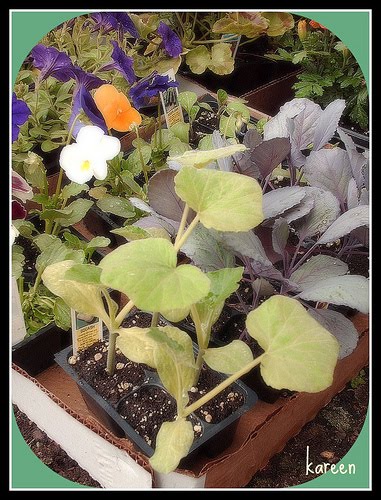
I bought a flat of annual Easy Wave Blue Petunias, a deep blue almost purple spreading petunia with a sweet fragrance.  To get me in the 'gardening zone,' I made up a couple of planters combining the Pansy, Coleus, Petunias and Marigolds before heading to the main vegetable garden; because the stars of Saturday's visit were the three vegetable starts. 

I chose the creamy skinned Butternut Squash, which I have never grown; Ichiban Eggplant - which promises long, slender and heavy yields all season long - and Red Cabbage.


Along with the red cabbage, I planted over twenty of the green Earliana Cabbage starts I had started indoors at the end of March.  In order to space out the harvest, another twenty smaller green cabbage starts will go in two weeks from now. 

Needless to say, I was finally on a roll.  I also planted three rows of Bush Lake 47 Green Beans (a compact, bush variety which harvests in 58 days), and one row of Mellow Yellow Beans (a bush bean maturing in 60 days). Both varieties are very productive and freeze well.

One row of yellow Saffron Squash - a straightneck summer type, one row of the prolific Sweet Zuke Hybrid Zucchini, and a half row of Vegetable Spaghetti Squash also went in.

In the main vegetable garden, the yellow, white and red onion bulbs are sprouting shoots.  In the potting shed garden, the corn, a sweet Burpee variety called Peaches & Cream, is up and growing thanks to the past few days of rain.  This is my first time growing this variety.  I typically plant either the Silver Queen or yellow and white bicolor, so I am eager to see how it does.

Progress has definitely been made :)

23.4.10

Anticipation

For some reason, I am getting a slow start this year.  It's not that the weather has been soggy....it's more like I am stuck in anticipation mode and cannot shift into action.

The yellow, purple and white onion sets are chilling downstairs.

The peas and leaf lettuce seeds are still in the metal seed box.  All three should have been in the dirt weeks ago....

At least the kitchen seed starts, facing the warm southern exposure, are growing:  Big Boy tomato, red, green and orange bell peppers, cabbage, portulaca, watermelon and two kinds of cherry tomato.

This Spring has been wonderful - the trees heavy with bloom and the flowers more vibrant than in year's past, especially the redbuds.  Maybe it's because of our prolonged, snowy and cold winter.  February broke the 1910 record for snow - 29.8 inches.  The long winter fed my anticipation and now, seemingly it was too well fed because I am ladened and immobilized.

The show, however, goes on outside even if I am still waiting in the wing.

Orange and purple viola

Perennial primrose

Tulips planted in the Fall, 2009

Daffodils

Kaga plum blossoms

Creeping phlox in the rock garden

14.3.10

Growing Impatient

Spring is coming; although, my impatience is already here, matured and ready for the harvest.

This time of year, just as spring begins to unfold, I read the poem, Ode to a Nightingale, by John Keats. It is a ritual I have kept for over thirty years.

A hauntingly beautiful poem written by a dying poet; who embraces his mortality and finds joy in the immortality of nature, and of the nightingale as it fills his soul with song and peace.  This is why I read his poem....as a reminder that nature, goes ever on and on even when my impatience wants to tell me otherwise. 

Ode to a Nightingale


My heart aches, and a drowsy numbness pains
My sense, as though of hemlock I had drunk,
Or emptied some dull opiate to the drains
One minute past, and Lethe-wards had sunk:
'Tis not through envy of thy happy lot, 

But being too happy in thine happiness,
That thou, light-wingèd Dryad of the trees,
In some melodious plot
Of beechen green, and shadows numberless,
Singest of summer in full-throated ease. 

O for a draught of vintage! that hath been
Cool'd a long age in the deep-delvèd earth,
Tasting of Flora and the country-green,
Dance, and Provençal song, and sunburnt mirth!
O for a beaker full of the warm South! 

Full of the true, the blushful Hippocrene,
With beaded bubbles winking at the brim,
And purple-stainèd mouth;
That I might drink, and leave the world unseen,
And with thee fade away into the forest dim: 

Fade far away, dissolve, and quite forget
What thou among the leaves hast never known,
The weariness, the fever, and the fret
Here, where men sit and hear each other groan;
Where palsy shakes a few, sad, last grey hairs, 

Where youth grows pale, and spectre-thin, and dies;
Where but to think is to be full of sorrow
And leaden-eyed despairs;
Where beauty cannot keep her lustrous eyes,
Or new Love pine at them beyond to-morrow. 

Away! away! for I will fly to thee,
Not charioted by Bacchus and his pards,
But on the viewless wings of Poesy,
Though the dull brain perplexes and retards:
Already with thee! tender is the night, 

And haply the Queen-Moon is on her throne,
Cluster'd around by all her starry Fays
But here there is no light,
Save what from heaven is with the breezes blown
Through verdurous glooms and winding mossy ways. 

I cannot see what flowers are at my feet,
Nor what soft incense hangs upon the boughs,
But, in embalmèd darkness, guess each sweet
Wherewith the seasonable month endows

The grass, the thicket, and the fruit-tree wild; 
White hawthorn, and the pastoral eglantine;
Fast-fading violets cover'd up in leaves;
And mid-May's eldest child,
The coming musk-rose, full of dewy wine,

The murmurous haunt of flies on summer eves. 
Darkling I listen; and, for many a time
I have been half in love with easeful Death,
Call'd him soft names in many a musèd rhyme,
To take into the air my quiet breath;
Now more than ever seems it rich to die, 

To cease upon the midnight with no pain,
While thou art pouring forth thy soul abroad
In such an ecstasy!
Still wouldst thou sing, and I have ears in vain—
To thy high requiem become a sod. 

Thou wast not born for death, immortal Bird!
No hungry generations tread thee down;
The voice I hear this passing night was heard
In ancient days by emperor and clown:
Perhaps the self-same song that found a path 

Through the sad heart of Ruth, when, sick for home,
She stood in tears amid the alien corn;
The same that ofttimes hath
Charm'd magic casements, opening on the foam
Of perilous seas, in faery lands forlorn. 

Forlorn! the very word is like a bell
To toll me back from thee to my sole self!
Adieu! the fancy cannot cheat so well
As she is famed to do, deceiving elf.
Adieu! adieu! thy plaintive anthem fades 

Past the near meadows, over the still stream,
Up the hill-side; and now 'tis buried deep
In the next valley-glades:
Was it a vision, or a waking dream?
Fled is that music:—do I wake or sleep?

14.2.10

A Winter Ritual

February marks the time of year when, under the constant barrage of cold, sunless days and endless snow, winter's newness and beauty begins to fade.

Now that the last of the blizzard's snow has been shoveled and the icicles have been knocked down from the gutter and down spouts, and there's nothing to be done about the ice dam that has formed over the front porch overhang, it's time to indulge.

The Gurney's and Dutch Garden colored catalogs need attention.  My gardening journal beckons to be opened.  It is a good ritual, this perusing and dreaming, of planning the yearly gardens. 

Prompted by news of a possible seed shortage - I had earlier dashed to get the Burpee order form in the mail, then hedged my bets and bought Picklebush Cucumber, Early Sweet Sugar Pie Pumpkin, Vegetable Spaghetti Squash, and Fordhook Zucchini seeds on Saturday from a local big box store.  Call it mild panic and overreaction, but I cannot imagine a garden without these vegetables nor would I take even the slightest risk of not having these seeds to plant. 

I can't however, breathe a sigh of relief until I score red, white and yellow onion sets.  These too are rumored to be in short supply this year.

In the meantime, I compiled my Gurney's order (a dwarf grapefruit tree, asparagus food, garden soil inoculant for peas and beans, two more square tomato cages); then, I visited with my journal reviewing the garden layouts from year's past, the yields, the purchases and some short journal entries:


There seems to be a common theme in my journal entries
- one of birds as harbingers -
and of evidence that, even in the dead of winter,
the rythmn of nature carries us forward into spring. 

January 9, 1999
 Birds sighted: 
 a flock of larks, cardinals, a red-bellied woodpecker,
bluejays, grackles, sparrows, titmouse, juncos,
 a red tail hawk and Canada geese.
-----
March 19, 2005: 
First red-winged blackbird of the season feeding
alongside some grackles outside the kitchen window. 
Started my yellow and green peppers, cabbage
and 3 kinds of tomatoes (yellow pear, sweet cherry and Big Boy).
-----
May 2, 2004
Barn swallows are back!

14.1.10

My Photo Entry

My sister told me about this great site, http://www.gardeninggonewild.com/, which combines photography and gardening.  Two of my passions.  I have entered the old apple tree in this month's winter photo contest.


10.1.10

It's a Winter Wonderland Out There!

Zone 5 gets its share of cold and snow.  Soon, Zone 5 should have its January thaw.  This is when the weather warms up enough to melt the snow.  Almost everyone gets excited to see the snow retreat by this time of winter....if only for a few days.  In the meantime, I was up early on Sunday and was rewarded with a spectacular sunrise and a landscape completely frosted over.  Winter does have its pluses.  Enjoy.


The old apple tree silhouette against the rising sun.


Sunrise casts long shadows across the untrodden landscape.


Spent Coneflowers stand firm against the frosty onslaught.


The sun rises over the distant Mugo Pines.


The frosty canopies of the Maple Trees
glow pink in the early morning sun.


Frost and a dollop of snow lend a sense of whimsy to this Maple.


The sun beams raise upward in a joyous Hallelujah.


The weak sunlight casts a white and yellow glow
across the neighbor's backyard.


Frost covers every needle on this White Pine.


These Coneflowes have a toppings of snow
making them resemble cotton ripening in a field.


The volunteer Oak sapling's frosty leaves still cling
tightly to its little branches.


The morning sun lights up the recent snowfall
reflecting back like a million tiny mirrors.

19.11.09

Knock Out Roses with Black-eyed Susans


While driving to and from the grocery store on Saturdays, I listen to 610's weekend call-in gardening program.  A couple years ago, I liked what I heard about Knock Out Roses.  They came so highly recommended.  I couldn't resist!  They were also reasonably priced.  I bought mine from Wal-Mart.

For me, hybrid roses have always been a challenge.  Although there is nothing quite like the grace, fragrance and beauty of a cultivated rose, I have had limited success with this flower.

In recent years, if the leaf spot didn't make make them unsightly, then the Japanese beetles did.

Sometimes, both disease and insect rendered my two hybrid rose bushes looking like something that had survived a war zone.

The Knock Out roses have had no leaf spot and the beetles don't go after them the way they do the hybrids.

Virtually carefree, this variety is compact, blooms continuously well into Fall and is fragrant. A perfect plant to grow around a deck.


24.10.09

Fall Has Come


I wish the maples would always be this color - a rich yellow
with twinges of orange.


The green berries of the bittersweet
have turned yellow with cherry-red centers


The sweetgum with its star shaped leaves
glows in shades of yellow, red and orange.

 
The pink "Knock-Out" roses continue to bloom
despite a hard frost.


I like to stand beneath the towering maples
and look up into their golden expanse.


As a child,
I used to collect and press the colorful fall leaves
in the leaves of heavy books; to visit them
in the winter or whenever my heart
wished to return to that moment in time.

29.9.09

On Bringing in the Seeds


Frugality. It is the buzzword of the day.
 It seems everyone has embraced this lifestyle.

I learned frugality from our parents. World War II as imputes: frugality in all things, even gardening.

My father collected seeds. He showed us how. Father also wintered geraniums and other plants. One of his prize geraniums, of Hungarian origin, was almost three feet tall. We referred to it as the “geranium tree:” deep red, a prolific bloomer even in winter.

A few years ago, seeing that my sister was doing what our father had done, I too started wintering geraniums. This year, some bright pinks will be added to the salmon and magentas. One day, maybe, just maybe, one or both of us will have a “geranium tree” to rival that of our father.


As for seeds, dill, forget-me-nots, yellow & orange marigolds, sugar pie pumpkin, purple phlox, orange cosmos, columbine and portulaca have been, once again, collected, dried, sealed and placed in a cool, dry place.

I, the frugal gardener. Like father, like daughters.

Or, perhaps it is habit. Tradition. An unwavering rite of summer's passage. Perhaps it is simply a pleasing thing to do this wintering and ‘bringing in the seed.’

Or maybe, it is an act of preserving something more: not just seeds or a favorite flower, but of preserving that invisible connection to our father, from whom we gleaned the knowledge and joy of gardening.


15.9.09

Time to Reflect on 2009

Sedum colors the late summer perennial bed
------
Another growing season is almost at an end.  2009 will go down as one of those weird years: Too cold, too wet and sometimes, too dry. 

I heard from several gardeners in Ohio and Pennsylvania that it was a challenging year.  So, when I hear some people didn't even get one ear of corn or someone else says their tomatoes rotted, I remind myself not to be a perfectionist.  My garden was good.  I was hoping for "over abundance," but "good" is good ;)

Cabbage, peppers, eggplant, beans are still producing.  A few tomato plants by the patio deck are rippening.  I started four tomato plants for indoors for the winter.  One already has blossoms.

The apple tree took a holiday this year and didn't produce much fruit.  The two pear trees, on the other hand, took up the slack.  Mom & I have been peeling, coring and freezing pint after pint of pears to use in making pear butter and bread over the winter.

I cleaned up the potting shed garden and hauled the corn stalks to the back compost pile.  There were 14 pie pumpkins in this garden.  In the next few days, they will be cooked down and made into pumpkin pie filling.

Lots to do as gardening in Zone 5 wraps up.